

AI has completely reshaped how people discover local businesses. Instead of just “10 blue links,” customers now get AI-generated answers, voice results, map snippets, and reviews summarized in real time. If you want your business to stay visible, you must intentionally optimize for ai local seo 2026 across search engines, maps, and AI assistants.
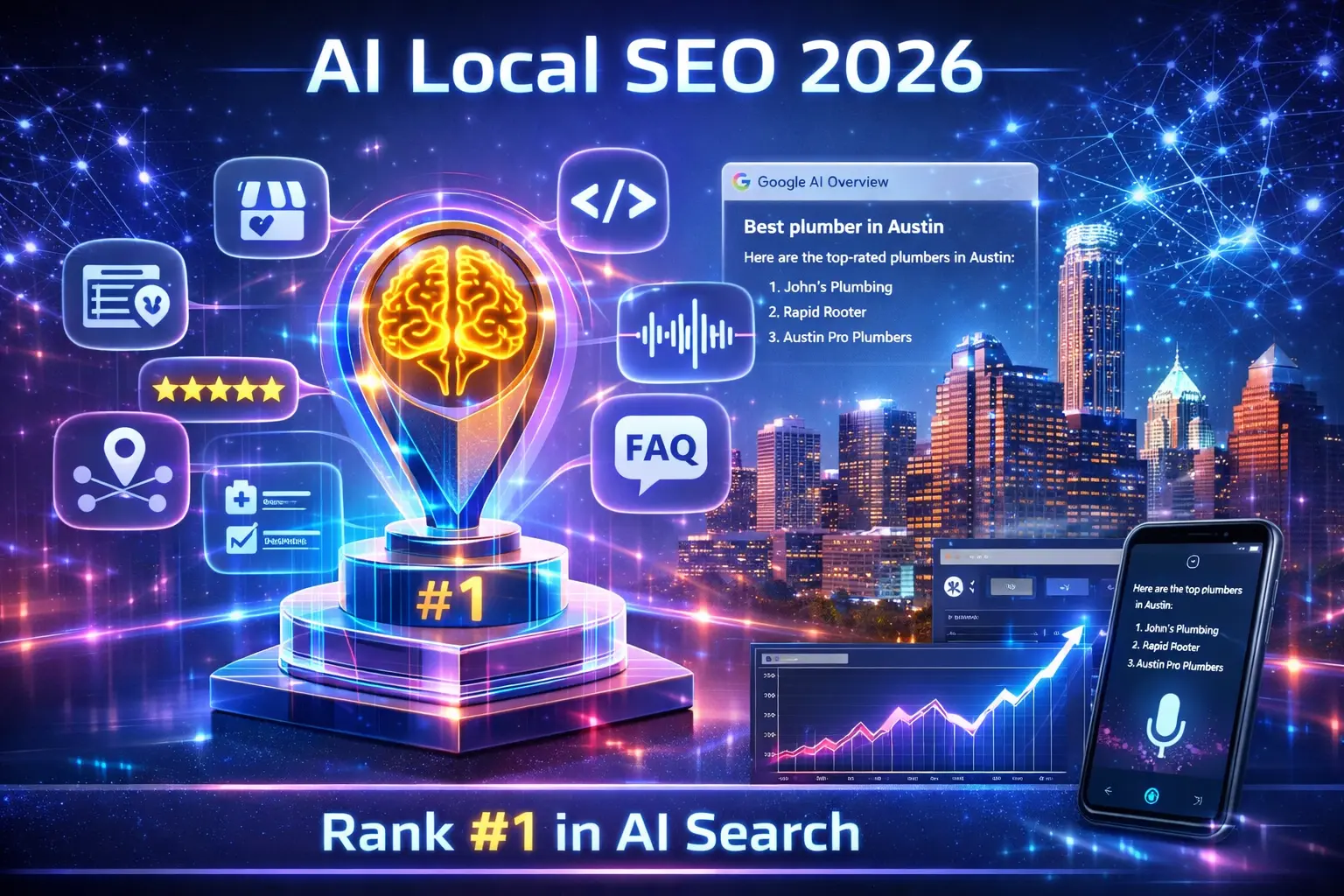
This guide explains what AI-driven local search is, how it works in 2026, and a practical step‑by‑step framework local businesses can use to drive more calls, visits, and bookings from AI search.
What Is AI Local SEO in 2026?
AI local SEO is the process of optimizing your online presence so that AI systems (Google AI Overviews, Bing Copilot, ChatGPT, voice assistants, and other answer engines) trust your business and choose it when users search locally.
In 2026, ai local seo 2026 goes beyond keywords and backlinks. AI models:
- Understand entities (your brand, location, services) and their relationships.
- Cross‑check your data across directories, social profiles, and reviews.
- Summarize the “best options” instead of listing every result.
- Personalize results based on user behavior, location, and intent.
If you are not clearly defined as a trustworthy local entity with consistent data, strong reviews, and helpful content, AI is less likely to recommend you.
How AI Is Changing Local Search Behavior
To win at ai local seo 2026, you need to understand how customers now search:
- They ask conversational questions instead of short keywords:
“Best dentist near me that takes Aetna and opens on Saturday.” - They use voice and mobile first:
Smart speakers, in‑car systems, and phone assistants read out a small set of options. - They expect answers, not lists:
AI recommends 2–5 businesses and summarizes why they’re a fit.
This means:
- There is less organic “real estate” (fewer slots to show up).
- AI puts more weight on reputation, consistency, and helpful content.
- You must optimize for both classic map pack SEO and AI answer engines.
Pillar 1: Build a Strong Local Entity (Data + Consistency)
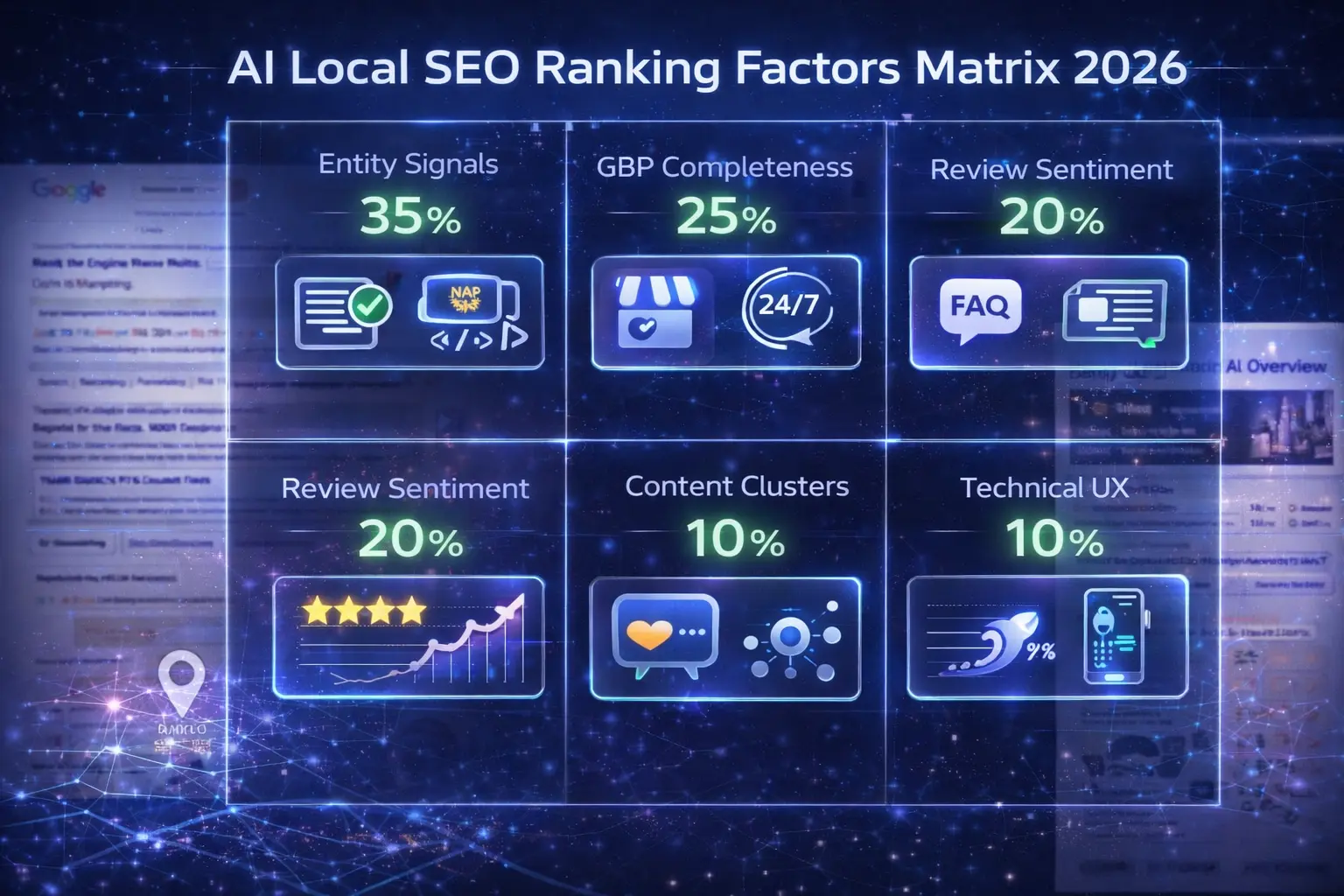
AI models first need to understand who you are before they can rank or recommend you. For ai local seo 2026, your business must be a clearly defined entity.
1.1 NAP Consistency Everywhere
NAP = Name, Address, Phone.
Make sure this is 100% identical across:
- Google Business Profile
- Apple Business Connect
- Bing Places
- Facebook Page
- Instagram Profile
- Major directories (Yelp, Yelp-equivalents in your country, industry directories)
- Your website (header, footer, contact page, schema)
Small differences (“Suite 3” vs “#3”) can confuse algorithms. Use one canonical format and stick to it.
1.2 Structured Data (LocalBusiness Schema)
AI systems lean heavily on structured data. For ai local seo 2026:
- Add
LocalBusiness(or a more specific subtype) schema to your site. - Include:
- Name, address, phone
- Opening hours
- Geo coordinates
- Service area (if applicable)
- SameAs links (GBP, Facebook, Instagram, Yelp, etc.)
This helps AI connect all your profiles to one entity.
1.3 Complete & Verified Profiles
For each major platform:
- Fill every field: description, categories, services, FAQs, photos, products.
- Use the same primary category and similar descriptions, adapted to each platform.
- Verify ownership and enable messaging / booking where possible.
The more complete and consistent your entity is, the easier it is to rank in ai local seo 2026 scenarios.
Pillar 2: AI‑Optimized Google Business Profile (GBP)
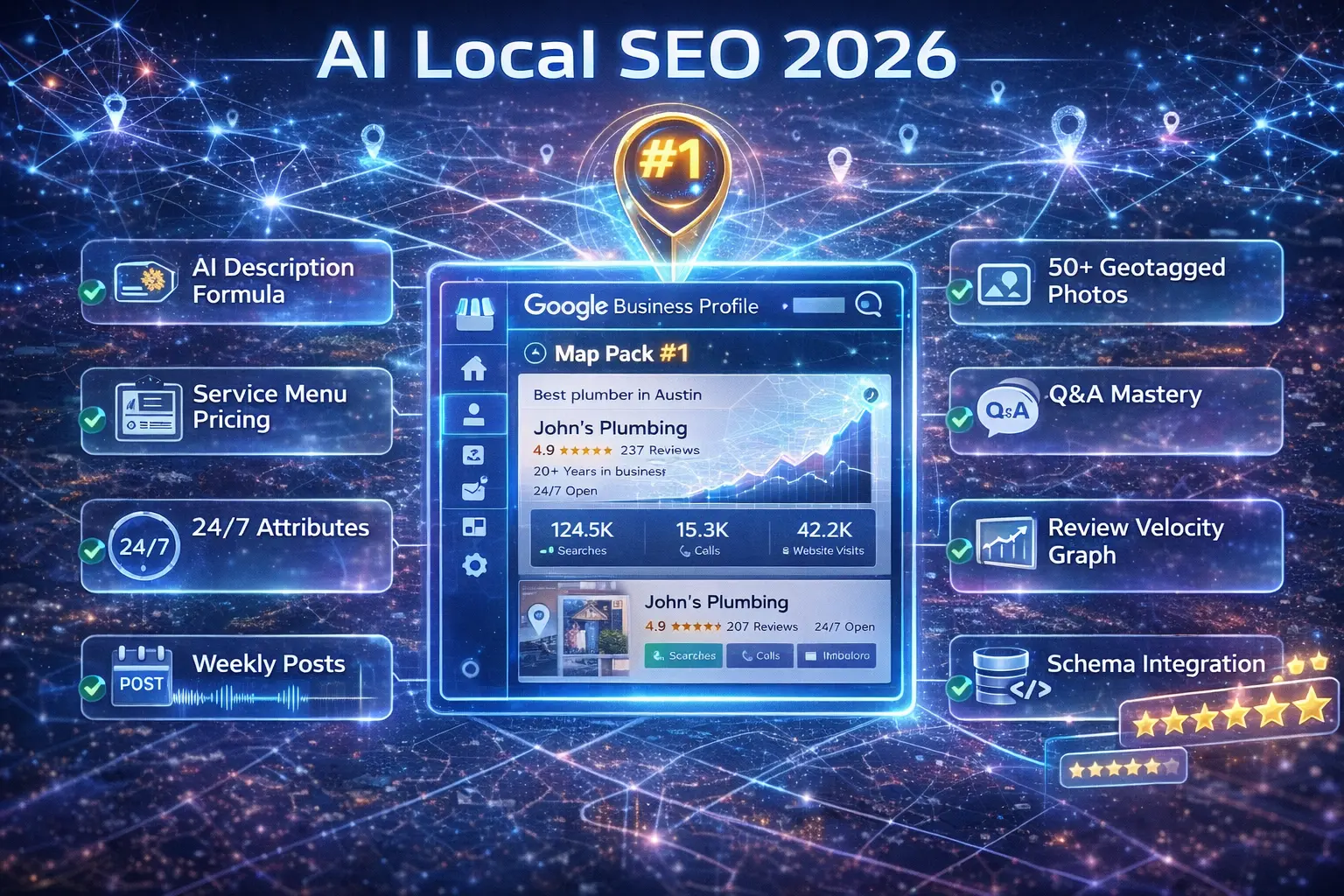
Google Business Profile is still the foundation of local visibility, and it heavily feeds AI Overviews and map results.
2.1 AI‑Friendly Business Description
For ai local seo 2026, write a description that:
- Uses your primary local keywords + city/area naturally.
- Clearly states what you do, who you serve, and your unique value.
- Includes 1–2 conversational phrases similar to how people speak.
Example (for a dentist in Austin):
“We’re a family dental clinic in Austin specializing in gentle cleanings, same‑day emergency visits, and cosmetic dentistry. We help busy families in South Austin get fast, stress‑free dental care with flexible hours and online booking.”
2.2 Services, Products, and Attributes
AI reads your services list as another data source:
- Add each service as a separate item with a short description.
- Use local modifiers when relevant (e.g., “emergency plumber in Denver”).
- Turn on attributes like “Women‑owned”, “Wheelchair accessible”, “LGBTQ+ friendly” where applicable—these are often used by AI‑powered filters.
2.3 AI‑Ready GBP Posts
Post weekly content that:
- Answers common questions (mini‑FAQs).
- Mentions location + service + benefit in natural language.
- Links back to relevant landing pages on your site.
Example GBP post:
“Looking for an emergency plumber in Chicago tonight? We offer 24/7 burst pipe and leak repair with under‑60‑minute response time in the Loop and River North. Call now or book online.”
These posts train AI models on when your business is the best answer.
Pillar 3: Content Strategy for AI Local SEO 2026
In 2026, content must support both classic SEO and AI answer engines.
The core rule: write like you’re answering a human, structure like you’re talking to an AI.
3.1 Topic Clusters Around Local Intent
Build content clusters around your main services + location. For ai local seo 2026, create:
- A main service page:
“Plumbing Services in Austin, TX” - Supporting content:
- “Emergency Plumber in Austin: What to Do When Pipes Burst”
- “Average Cost of Plumbing Repairs in Austin (2026 Guide)”
- “How to Choose a Plumber in South Austin: 7 Questions to Ask”
Each supporting article:
- Links back to the main service page.
- Mentions your city, neighborhoods, and real local references.
- Includes Q&A style sections AI can easily quote.
3.2 FAQ and Q&A Sections
AI loves direct Q&A. Add FAQs to:
- Service pages
- Location pages
- Blog posts
Use actual spoken‑style questions:
- “How much does an emergency plumber cost in Austin?”
- “Do you offer same‑day AC repair in Dubai?”
- “Can I book a dentist appointment online in Boston?”
Answer in 2–4 sentences, clear enough for AI to extract as a snippet.
3.3 E‑E‑A‑T for Local Businesses
AI models prefer businesses that demonstrate:
- Experience: Real case studies, before/after photos, testimonials.
- Expertise: Detailed guides, how‑tos, local data references.
- Authoritativeness: Mentions on reputable sites, local news, industry bodies.
- Trustworthiness: Clear policies, reviews, consistent contact info.
Show this on your website with:
- “About the Owner” section with local background.
- Case studies (“How we helped a restaurant in Downtown Seattle reduce delivery wait times”).
- Logos of associations, certifications, and partners.
Pillar 4: Reviews, Reputation, and AI Sentiment
For ai local seo 2026, reviews are not just stars—they are training data. AI models analyze:
- Average rating
- Volume and recency
- Keywords mentioned in reviews
- Sentiment around specific services or locations
4.1 Systematic Review Generation
Create a simple, consistent review system:
- Ask after every completed service or visit.
- Send a short SMS or email with one link directly to GBP.
- Use friendly, specific prompts:“If we solved your problem today, could you share a quick 1–2 sentence review on Google mentioning the service you received? It helps other people in [city] find us.”
Aim for:
- Steady review velocity (a few per week, not occasional bursts).
- Detailed reviews mentioning service + city + result.
4.2 Responding Like AI Is Reading (Because It Is)
When you reply to reviews:
- Echo the important keywords naturally:
“Thanks for trusting us with your emergency AC repair in Houston.” - Add context:
“We’re glad we could get your system running again the same day.”
For negative reviews:
- Stay calm, professional, and solution‑oriented.
- Show that you take responsibility and offer remedies.
This helps AI understand you are reliable and customer‑focused, which supports ai local seo 2026 ranking signals.
Pillar 5: Voice Search & Conversational Queries
Voice and AI chat interfaces are exploding. People talk to them like a human, not like a search box.
5.1 Optimize for Natural Language
Include natural phrases in your content:
- “Who is the best…”
- “Where can I find…”
- “What’s the cheapest way to…”
- “Can I get [service] near [neighborhood] today?”
Use these as H2/H3 headings with direct answers below.
5.2 “Near Me” and “Open Now” Intents
For ai local seo 2026, AI often resolves “near me” queries by:
- Understanding your service area
- Checking your opening hours
- Looking at proximity + rating + relevance
Make sure:
- Your opening hours are accurate across all platforms.
- You mention service areas and neighborhoods explicitly.
- Your schema and content clarify when you’re available (24/7, same‑day, evenings).
Pillar 6: AI Tools Local Businesses Can Use Today
You don’t need to be a data scientist to benefit from AI. You can use AI tools to do local SEO faster and better.
6.1 AI for Keyword & Intent Research
Use AI‑powered keyword tools or general AI models to:
- Generate lists of local keywords:
“best + [service] + [city]”, “near me”, “open now”, “emergency”, “same day”. - Group keywords by:
- Awareness (what is, how does it work)
- Consideration (best options, comparisons)
- Conversion (book, call, near me now)
This helps shape your content calendar around real search behavior.
6.2 AI for Content Drafting (Human‑Edited)
You can:
- Draft outlines for location pages and service pages.
- Generate FAQ ideas.
- Create alternate versions of headlines and meta descriptions.
Always:
- Fact‑check details (prices, laws, regulations, local realities).
- Add your own examples, stories, and brand voice.
- Make sure content matches how you actually operate.
6.3 AI for Monitoring & Reporting
Use AI‑enhanced tools (in your rank tracker, analytics, or GBP insights) to spot:
- Drops in map rankings for specific neighborhoods.
- Competitors gaining more reviews or content.
- Pages with high impressions but low clicks.
This lets you focus your ai local seo 2026 work where it matters most.
Pillar 7: Local Links, Citations, and Community Signals
AI evaluates trust partly through where you are mentioned and linked.
7.1 Smart Citations
Prioritize:
- Major generic directories (Google, Apple, Bing, Yelp, etc.).
- Quality industry‑specific directories (e.g., healthcare, legal, home services).
- Local directories and chambers of commerce.
Ensure your NAP is consistent as discussed earlier.
7.2 Local Backlinks with Real Value
Focus on real‑world connections that also create links:
- Sponsor local events, charities, or sports teams.
- Collaborate with neighborhood associations.
- Write guest articles for local blogs or news sites.
- Create local guides (e.g., “Best coffee near [landmark]”) and pitch them to local media.
AI models see these as signals that you are embedded in the community, which supports ai local seo 2026 rankings.
Pillar 8: Technical & UX Foundations
Even in an AI‑driven world, fundamentals still matter.
8.1 Site Speed & Mobile UX
Most local searches happen on mobile. Make sure:
- Pages load in under ~2–3 seconds on 4G.
- Buttons are large and easy to tap.
- “Call” and “Directions” are always prominent.
- You use clear headings and short paragraphs.
8.2 Clear Conversion Paths
Ask yourself: if AI sends a highly qualified visitor to your site, can they:
- Call you in one tap?
- See your address and hours instantly?
- Book online without friction?
Align your ai local seo 2026 strategy with conversion optimization so that visibility turns into revenue.
Implementation Roadmap: 30‑Day AI Local SEO 2026 Plan
Here’s a simple, practical plan you or your clients can execute.
Week 1: Entity & Profile Cleanup
- Standardize NAP across all platforms.
- Update and fully complete Google Business Profile.
- Add LocalBusiness schema to your site.
- Fix any glaring technical issues (slow pages, broken links).
Week 2: Content & FAQ Foundation
- Create or update:
- Main service pages for each core service + city.
- At least one detailed local guide or comparison article.
- Add FAQ sections on:
- Pricing
- Availability
- Service areas
- Common objections
Week 3: Reviews & Reputation
- Set up a simple review request system (email/SMS template).
- Aim for 5–10 fresh reviews this week.
- Respond to all existing reviews (old and new) with keyword‑rich, human replies.
Week 4: AI‑Driven Optimization & Expansion
- Use AI tools to:
- Identify new local keyword opportunities.
- Generate content ideas for next 3 months.
- Analyze which neighborhoods or services are under‑represented.
- Plan 2–4 new pieces of content that target:
- Specific neighborhoods
- High‑intent questions
- Seasonal or event‑based search spikes
Repeat this 4‑week cycle every quarter, improving and expanding based on results.
Conclusion: Winning AI Local SEO in 2026
To win with ai local seo 2026, local businesses must:
- Think like an entity, not just a website.
- Treat Google Business Profile as a living asset.
- Publish content designed for both humans and AI answer engines.
- Invest in real reputation: reviews, local links, and community presence.
- Use AI tools to accelerate research, content, and analysis—then add human judgment on top.
The businesses that start now will dominate AI‑driven local search in the next 12–24 months, while slower competitors wonder where their calls and walk‑ins went.
Also see:
