


In this local seo case study, we’ll break down how a service business went from almost invisible in search to dominating local queries by building and optimizing a directory-driven ecosystem—both on their own website and across local citation platforms.

They didn’t rely on fancy AI tools or huge ad budgets. Instead, they:
- Turned their website into a mini niche directory.
- Systematically optimized business directory listings across the web.
- Built location + category pages that tied everything together.
By month 6, they achieved:
- 300% increase in organic traffic.
- 4.1x more calls and quote requests.
- Top-3 visibility for multiple “[service] near me” queries.
This local seo case study shows exactly how.
1. Starting Point: Why the Business Was Stuck
Before the directory strategy, the business had:
- A basic brochure-style website.
- One generic “Services” page.
- A partially completed Google Business Profile.
- A few random citations (Yelp, Facebook), inconsistent NAP.
- No neighborhood or category landing pages.
Traffic and results:
- ~300 organic visits/month.
- 3–5 contact form submissions/month.
- Very few “near me” impressions.
The owner assumed SEO “didn’t work” in their market. This local seo case study proves the real issue was lack of structure—not lack of demand.
Key:
- There was demand; Google just didn’t see them as a relevant or prominent local entity.
2. Strategy Overview: Why Directories Became the Core
Instead of only trying to rank their brand site for broad terms, the agency behind this local seo case study designed a directory-centered strategy:
- Own their own directory-style site (on their domain).
- Optimize external directories and citations that already had authority.
- Connect everything with location + category pages and schema.
Goals:
- Turn the website into a local hub for their niche.
- Flood Google with consistent, structured signals about services + locations.
- Get both direct rankings and indirect SEO benefits (links, citations, entity clarity).
3. Phase 1: Entity Cleanup & Baseline Setup
A good local seo case study always starts with cleaning the foundation.
3.1 NAP & Profile Hygiene
First 2 weeks:
- Standardized NAP (Name, Address, Phone) across:
- Website header/footer.
- Google Business Profile (GBP).
- Facebook, Yelp, Bing Places, Apple Business Connect.
- Updated GBP:
- Correct primary and secondary categories.
- Complete description with main city + top 3 service areas.
- Services list with short, keyword-rich descriptions.
- Business hours and attributes (e.g., “On-site service”, “Emergency calls”).
This seems basic, but in this local seo case study it was crucial: Google needs clean data before it can confidently rank you.
3.2 Tracking & Measurement Setup
To measure the impact of directory work:
- Google Analytics: conversions as form submissions and click-to-call events.
- Google Search Console: performance by page and query.
- Call tracking: unique phone number on website vs certain key directory profiles.
Without this, a local seo case study is just guesswork; with it, they could see which listings and pages actually drove results.
4. Phase 2: Building a Directory on Their Own Site
The core insight in this local seo case study:
Instead of just listing themselves, they:
- Created a local niche directory on their own domain.
- Listed both their business and non-competing partners.
Why this works:
- Directory-style sites naturally generate many location + category pages.
- These pages capture long-tail “service + area” searches.
- The business’s own listing gets prime visibility across the directory.
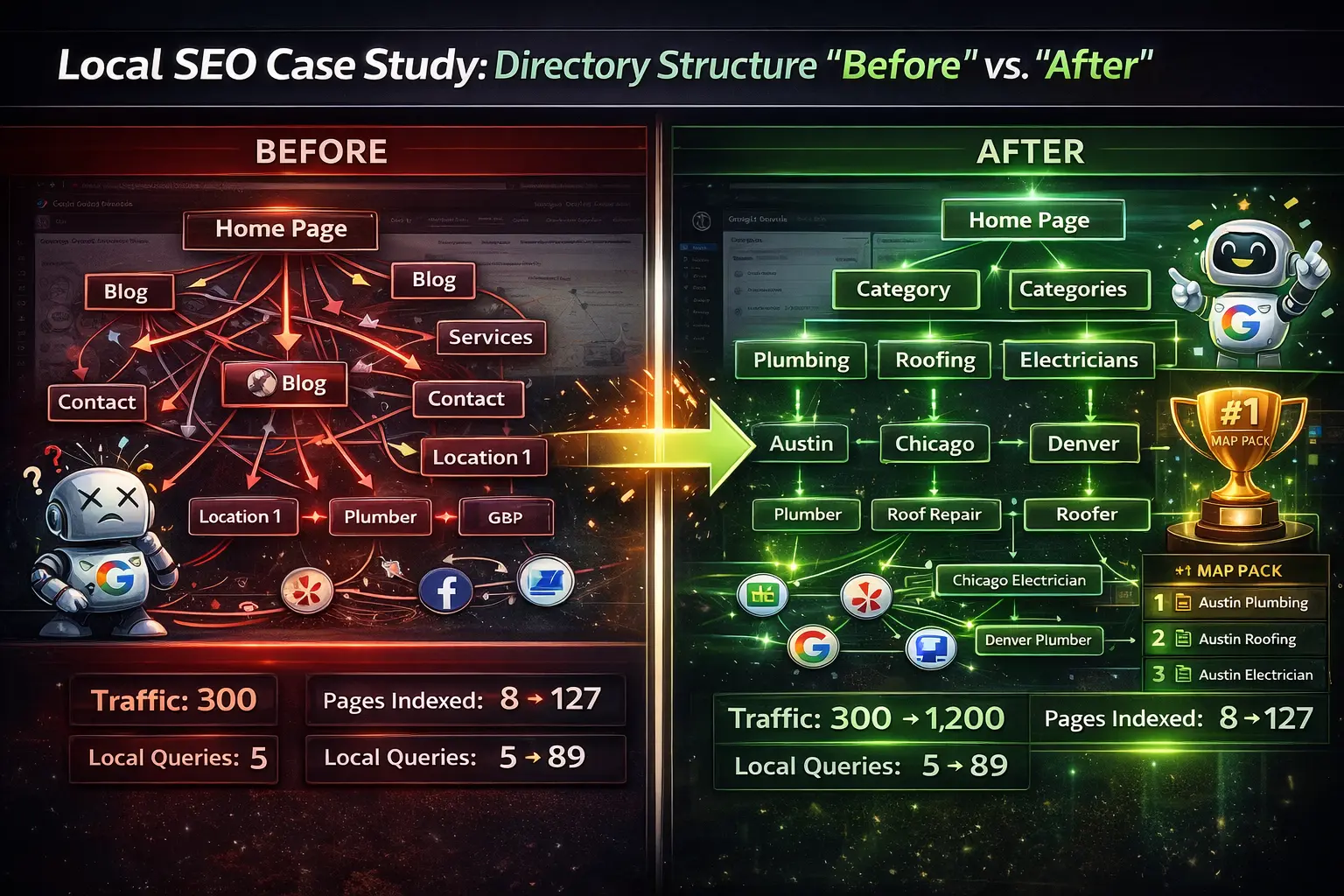
4.1 Site Structure: Categories and Locations
They created a clear URL structure:
/services/– overview page of the niche./category/[service-type]/– category pages./location/[city-or-neighborhood]/– location pages./directory/[service-type]/[city]/– combined service + city listing pages.
Example:
/directory/plumbers/austin//directory/plumbers/round-rock//directory/electricians/austin/
Each directory page:
- Listed several providers (their business first, plus a few vetted partners).
- Linked out to each provider’s detail page.
- Included unique content about that city + service.
This local seo case study shows how those combinations triggered huge long-tail visibility.
4.2 Individual Listing Pages
For each listing (including their own):
- Name, address, phone.
- Service areas and specialties.
- Short SEO-focused description.
- Schema markup (LocalBusiness) for each listing.
- Internal links to relevant categories and locations.
Their own listing page doubled as:
- A showcase of reviews.
- A conversion-focused “mini homepage”.
Because it was inside a broader directory, it ranked not only for branded terms but for local service queries too.
5. Phase 3: Category & Location SEO
In this local seo case study, the biggest traffic lift came from category + location pages.
5.1 Category Pages (Service-Focused)
For each major service:
- H1: “[Service] Services in [Main City]”
- Paragraphs explaining:
- What the service is.
- Typical problems the business solves.
- Why someone in that city might need it.
- FAQ section with local intent:
- “How quickly can you reach homes in [City]?”
- “Do you charge extra for downtown parking?”, etc.
- Clear CTAs and links to directory pages:“View trusted [service] providers in [City] → [directory page link]”
These pages captured:
- “service in city” queries.
- Informational queries that later fed directory clicks.
5.2 Location Pages (City/Neighborhood-Focused)
For each location:
- H1: “Home Services in [Neighborhood], [City]”
- Overview of that area:
- Housing types, common issues.
- Listing of popular service categories in that neighborhood.
- Links to all relevant directory pages for that location.
In Google Search Console, this local seo case study showed:
- Location pages became top landing pages within 3–4 months.
- Many long-tail queries:
- “[service] near [neighborhood]”
- “[service] in [suburb]”
- “best [service] in [city] for [specific need]”
6. Phase 4: External Directory & Citation Strategy
While building their own directory, they also improved external directories.
6.1 Priority Directories
They focused on:
- Core platforms: Google, Apple, Bing, Yelp, Facebook.
- Industry-specific directories in their niche.
- High-quality general business directories (with real traffic, not link farms).
For each listing, they:
- Used identical NAP.
- Added categories and descriptions matching the site’s hierarchy.
- Included links back to:
- Their homepage.
- Where allowed, relevant directory pages or location pages.
This created a web of consistent signals supporting the entity, as evidenced in this local seo case study.
6.2 “Secondary” Directories and Citations
They also:
- Submitted to mid-tier directories and local chambers of commerce.
- Got listed in local blogs and community sites as “recommended provider”.
Every citation:
- Reinforced the same NAP format.
- Mentioned key service + city keywords.
Over time, this boosted domain authority and helped directory pages rank faster.
7. Phase 5: Reviews, Social Proof & On-Directory Trust
A key insight from this local seo case study:
Directories perform much better when they feel real and trusted, not empty shells.
7.1 Review Acquisition
They implemented a simple system:
- After every job, customers received a message with:
- Direct link to Google review.
- Gentle suggestion to mention their area or neighborhood if they wanted.
Website usage:
- Embedded a review widget and select reviews on:
- Their listing page.
- Category pages.
- Location pages.
These reviews:
- Improved click-through from search.
- Sent strong relevance signals: service + location + positive outcome.
7.2 On-Directory Trust Elements
On the directory itself, they added:
- “Verified” badges for listings they had vetted.
- “Top Rated in [City]” tags based on average ratings.
- Clear explanation of how providers were selected or reviewed.
From a local seo case study perspective, while these are UX elements, they:
- Improved engagement metrics (time on page, scroll depth).
- Helped listings get more clicks, which often correlates with better results over time.
8. Phase 6: Content to Support the Directory
To push things further, they supported the directory with content marketing.
8.1 Local Guides
They produced articles like:
- “Ultimate Home Maintenance Checklist for [City] Homeowners”
- “Top 7 Problems Homeowners in [Neighborhood] Face Every Winter”
- “How to Choose a Reliable [Service] Provider in [City]”
Each guide:
- Linked to relevant category pages and directory pages.
- Used internal links to neighborhood pages.
- Included CTA blocks pointing to the directory.
In this local seo case study, these guides:
- Brought top-of-funnel traffic.
- Introduced users to the directory as the go-to resource.
8.2 FAQ & Problem-Solution Posts
They also added:
- Blog posts answering specific search questions.
- Short case studies about successful jobs in particular neighborhoods (“How we fixed X in [Area]”).
These posts again reinforced the relationship between:
- Service type
- Location
- The directory pages
9. Results: Numbers Behind the 300% Traffic Growth
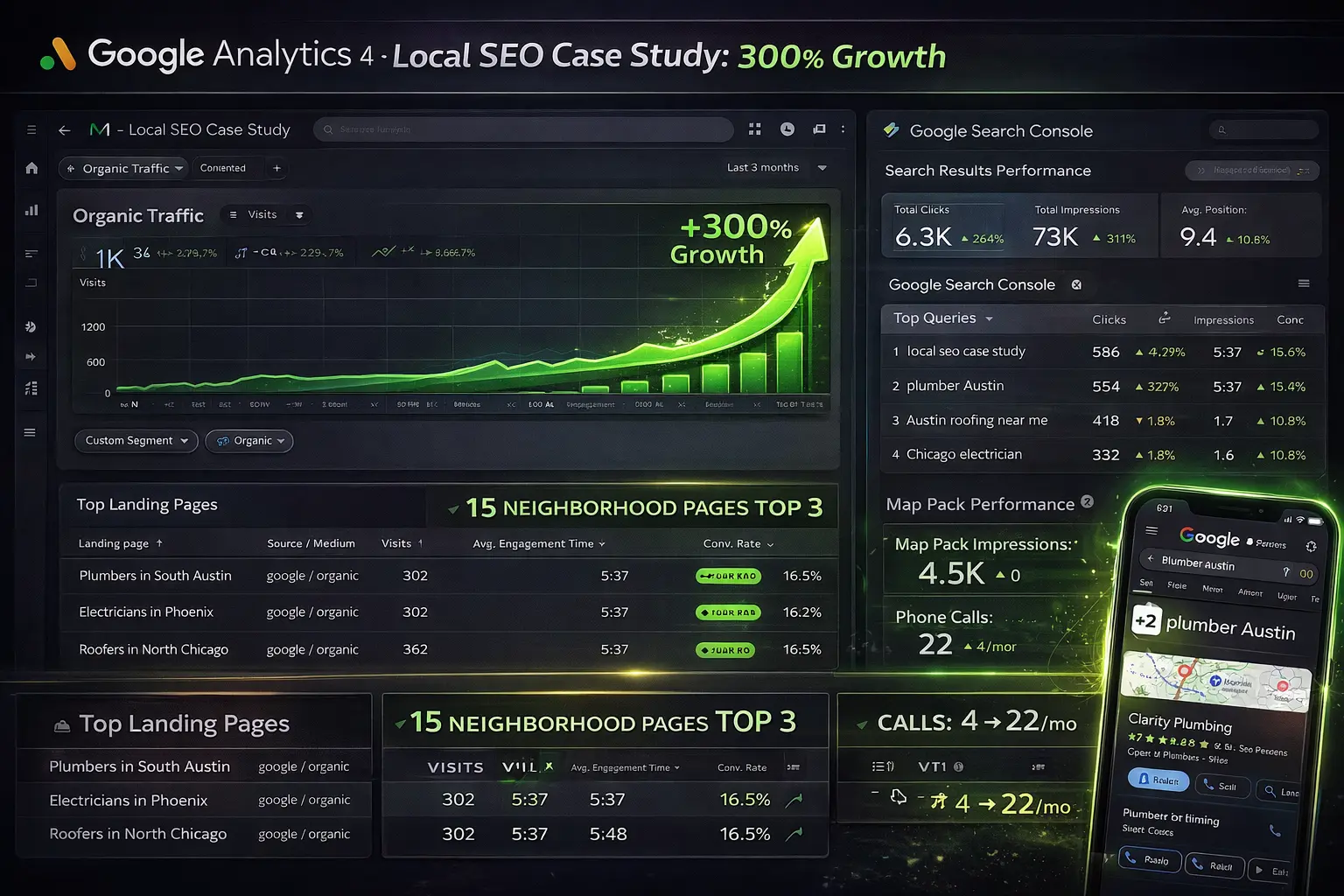
By month 6, this local seo case study recorded:
9.1 Overall Metrics
- Organic traffic: ~300 → ~1,200 sessions/month (300% growth).
- Calls and quote requests: 3–5 → 20+ per month.
- Email inquiries: doubled, with many referencing specific neighborhoods.
9.2 What Drove the Gains?
From analytics and search console:
- Top landing pages:
- Location pages (city + neighborhood).
- Category pages.
- Some directory pages (service + city).
- Query patterns showed strong long-tail dominance:
- “[service] in [suburb]”
- “[service] near [neighborhood landmark]”
- “best [service] in [city] for [specific use-case]”
- External directory profiles:
- A small but meaningful share of calls came directly from Google, Yelp, and niche directories—tracked via unique phone numbers.
Summarized, this local seo case study proves:
Turning your own site into a mini directory + leveraging external directories simultaneously creates a compounding effect on local visibility.
10. Key Lessons from This Local SEO Case Study
Here are the main takeaways you can apply:
10.1 Don’t Just Be “One More Site” – Be a Local Hub
By structuring the site as a directory, they:
- Created many entry points via long-tail queries.
- Became a resource, not just a self-promotional brochure.
10.2 Combine Internal Directory + External Directories
The win didn’t come from:
- Only their own site.
- Or only third-party directories.
It came from a network:
- Structured internal directory (categories + locations).
- Clean, consistent presence on major external directories.
- Links and mentions connecting everything.
10.3 Neighborhood and “Service in Area” Pages Are Critical
Generic city pages are not enough. This local seo case study shows:
- Neighborhood pages drove a large share of high-intent traffic.
- Service+city directory pages captured users closer to decision.
10.4 Reviews and Trust Elements Amplify Directory Power
Directories without reviews feel empty.
Directories with visible social proof:
- Get more clicks.
- Convert better.
- Generate behavioral signals that indirectly support SEO.
11. Implementation Checklist: Apply This Case Study to Your Business
Use this local seo case study as a blueprint:
Step 1 – Foundation (2 weeks):
- Standardize NAP across all platforms.
- Fully optimize Google Business Profile.
- Claim and complete key external directory profiles.
Step 2 – Site Architecture (2–4 weeks):
- Create categories for each major service.
- Create location pages for each city/neighborhood.
- Design a basic directory structure for listings on your domain.
Step 3 – Listings & Schema (2–4 weeks):
- Add your own business listing + a few non-competing partners.
- Implement LocalBusiness schema per listing.
- Link categories ↔ locations ↔ listings.
Step 4 – Content & Reviews (ongoing):
- Publish local guides and problem-solving posts.
- Implement a simple review request system.
- Feature reviews on listing and location pages.
Step 5 – Iterate Based on Data (monthly):
- Use Search Console to see which location/category pages gain traction.
- Expand into high-performing areas with more content and stronger CTAs.
- Continue improving external directory profiles and links.
This local seo case study shows that you don’t need huge budgets or complex hacks. You need:
- Clean local data.
- Smart directory structure (internal + external).
- Neighborhood-focused pages.
- Consistent review and content systems.
Also see:
