
A real estate agent directory can become the go‑to place for buyers and sellers searching “realtor near me,” “agent in [neighborhood],” or “[city] real estate specialist.” When your directory is built around neighborhoods—not just cities—you match exactly how real people search and how they think about where they want to live.
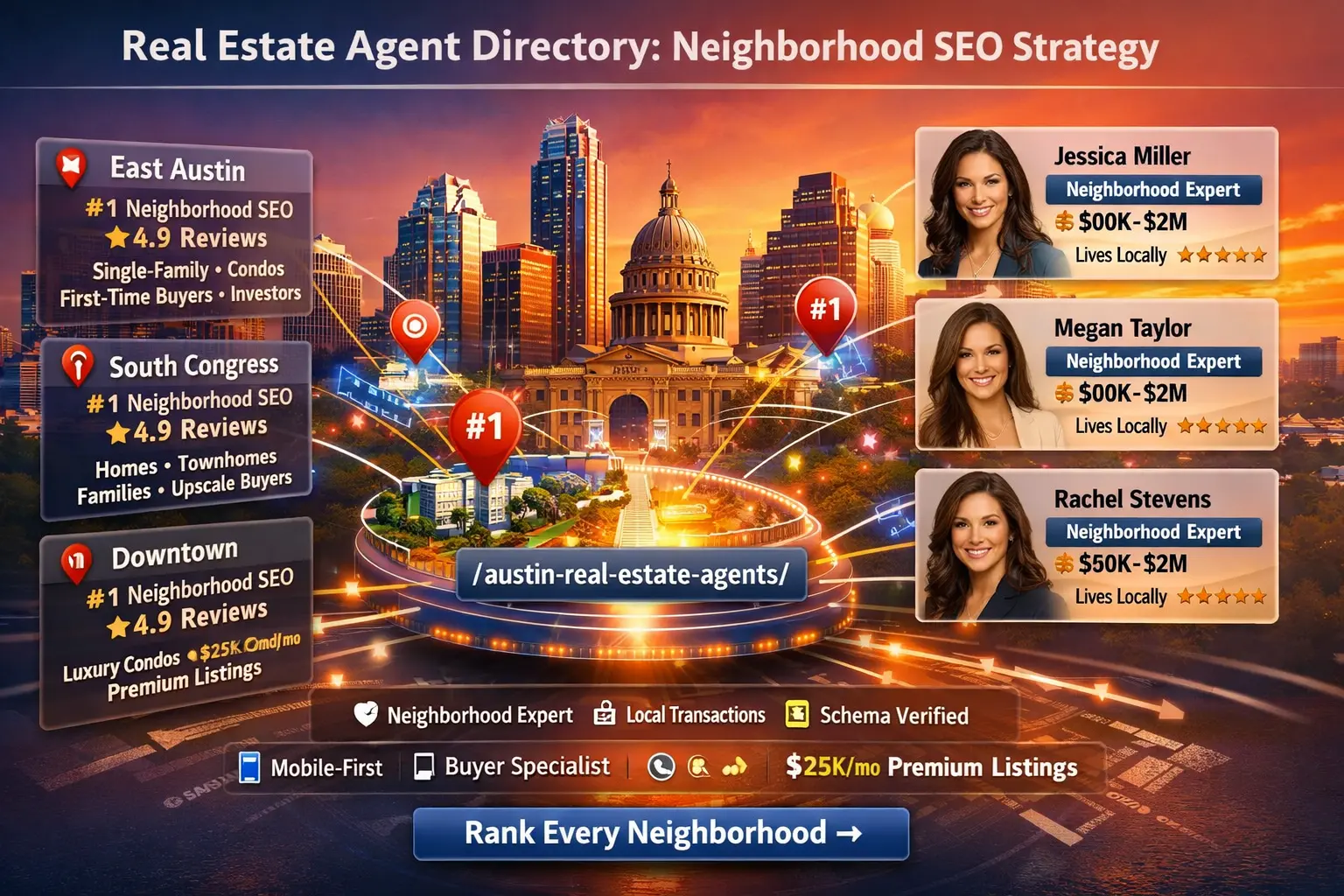
This guide shows you how to design, optimize, and monetize a real estate agent directory using a neighborhood‑first SEO strategy that works in 2026 and beyond.
Why Neighborhood SEO Matters for Agent Directories
Buyers rarely search “real estate agent United States.” They search like this:
- “real estate agent in East Austin”
- “realtor near Lincoln Park Chicago”
- “buy house in Queen Anne Seattle”
A neighborhood‑optimized real estate agent directory wins because:
- It matches long‑tail, high‑intent searches (lower competition, better leads).
- It lets you showcase agents who specialize in micro‑markets.
- It builds trust—people want agents who live and work in specific areas, not just generalists.
When you build pages for city → neighborhood → agents, your directory can rank for dozens of low‑competition, high‑value keywords instead of fighting mega‑sites on broad city terms only.
Directory Structure for Neighborhood SEO
Your URL and site structure must reflect how people search. For a real estate agent directory, a clean hierarchy looks like this:
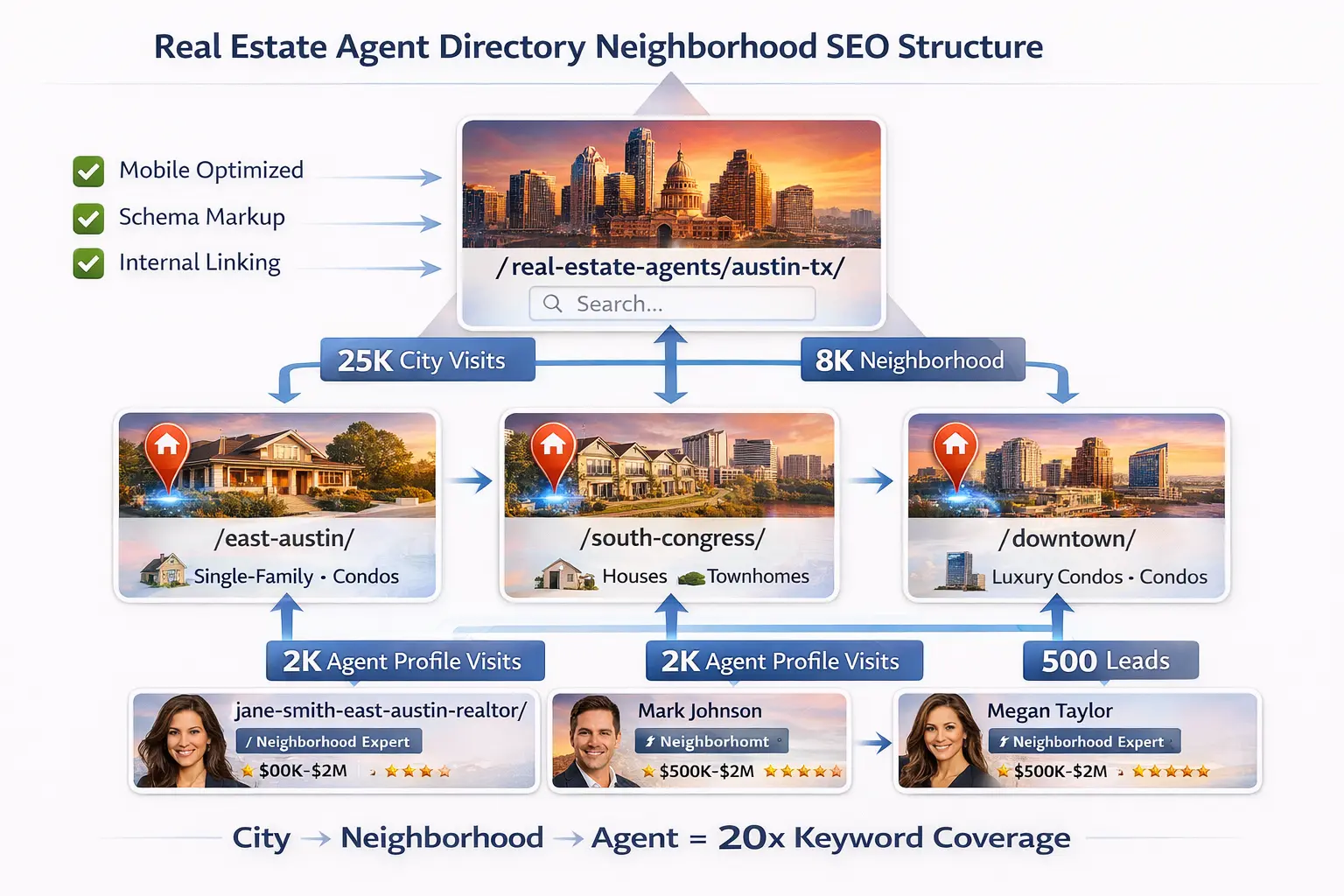
- City hub pages:
/real-estate-agents/austin-tx//real-estate-agents/chicago-il/
- Neighborhood pages:
/real-estate-agents/austin-tx/east-austin//real-estate-agents/austin-tx/south-congress//real-estate-agents/chicago-il/lincoln-park/
- Agent listing pages:
/listing/jane-smith-realtor-east-austin//listing/john-doe-lincoln-park-agent/
This structure gives you:
- City pages targeting “[city] real estate agents.”
- Neighborhood pages targeting “[neighborhood] [city] real estate agent directory.”
- Individual agent pages targeting branded and “best agent in [neighborhood]” searches.
Keep URLs short, readable, and consistent. Use hyphens, include city and neighborhood, and keep all real estate content under one logical path (/real-estate-agents/).
City Hub Page Template: “[City] Real Estate Agents”
City hub pages are your top‑level entry points for each market.
Suggested structure (600–900 words)
- Title tag: “Real Estate Agents in [City, State] – Top Local Realtors”
- Meta description: “Find real estate agents in [City, State] by neighborhood, price range, and property type. Compare local Realtors with reviews, areas served, and experience.”
- H1: “Real Estate Agents in [City, State] – Local Realtors by Neighborhood”
Sections you should include:
- City overview for buyers and sellers
- Brief description of the city’s housing market.
- Mention average home price ranges and property types (condos, single‑family, townhomes).
- Neighborhood list and map
- Grid or map with major neighborhoods.
- Each neighborhood name links to its own neighborhood agent page.
- Property types and buyer profiles
- First‑time buyer neighborhoods.
- Luxury markets.
- Investor‑friendly areas.
- How to choose a real estate agent in [City]
- Experience in your desired neighborhood.
- Recent transactions.
- Communication style and availability.
- Featured agents in [City]
- A small selection of top or featured agents with profile snippets and calls to action.
Your city page should internally link to:
- Each neighborhood page.
- Key agent profiles.
- Supporting content like “Best neighborhoods in [City] for families” if you have a blog.
Neighborhood Page Template: Hyper‑Local Authority
Neighborhood pages are where your real estate agent directory really stands out. Most competitors barely cover neighborhoods; you will.
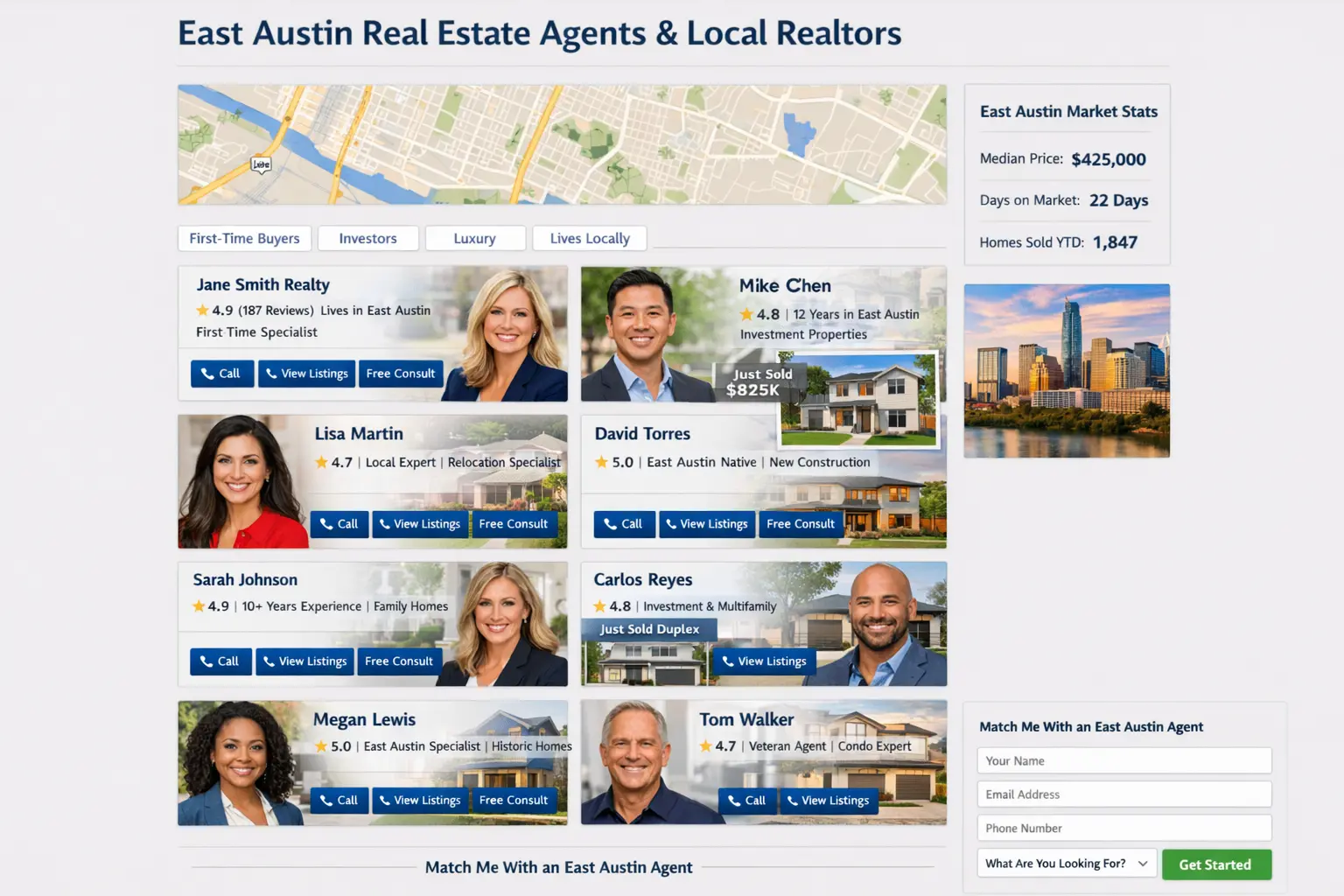
Suggested structure (500–800 words)
- Title tag: “[Neighborhood] [City] Real Estate Agents – Local Realtors & Specialists”
- Meta description: “Find real estate agents in [Neighborhood], [City]. Local Realtors who specialize in [property types]. Explore schools, lifestyle, and homes for sale in [Neighborhood].”
- H1: “[Neighborhood] [City] Real Estate Agents & Local Realtors”
Sections:
- Neighborhood overview
- Where it is in the city.
- Vibe (urban, family‑friendly, historic, waterfront, etc.).
- Typical buyers: first‑time, families, luxury, investors.
- Housing market snapshot
- Common property types.
- Rough price ranges (avoid specific numbers if they change often; focus on affordable/midrange/luxury segments).
- Recent trends (popular with remote workers, new developments, revitalization, etc.).
- Agents who specialize in [Neighborhood]
- List of agents with badges like “Lives in [Neighborhood]”, “10+ years in [Neighborhood]”, “Top listing agent.”
- Short description per agent (see profile template below).
- Why use a neighborhood specialist?
- Local market knowledge (off‑market listings, realistic pricing).
- School and commute insight.
- Negotiation advantage from knowing current demand.
- Call to action
- “Match me with a [Neighborhood] agent.”
- “View all [Neighborhood] listings.”
Connect each neighborhood page back to the city hub and to individual agent profiles. This creates strong internal linking and helps search engines understand topical relationships.
Agent Profile Template for Real Estate Directories
For a real estate agent directory, agent pages need to be more than simple contact cards. They must sell the agent’s local expertise.
Key components (400–700 words)
- Title tag: “[Agent Name] – Real Estate Agent in [Neighborhood] [City]”
- Meta description: “[Agent Name], real estate agent in [Neighborhood], [City]. [X] years experience, [property types], [buyer/seller focus]. Contact for a free consultation.”
- H1: “[Agent Name] – [City] Real Estate Agent”
Sections:
- Hero summary (above the fold)
- Headshot/logo.
- Rating (if you collect reviews).
- Years of experience.
- Primary neighborhoods served.
- “Call / Email / Schedule a Call” buttons.
- About [Agent Name]
- Short bio: how long they’ve worked in the area, specialties, awards, associations.
- Focus on local credibility: “Lives in [Neighborhood] since [year]”, “Closed [number] homes in [area] last year” (if accurate).
- Neighborhoods & areas served
- Primary neighborhoods, with internal links to your neighborhood pages.
- Mention citywide coverage if applicable, but highlight their strongest markets.
- Property types & client focus
- First‑time buyers, downsizers, investors, luxury buyers, etc.
- Condos, townhouses, single‑family homes, new construction.
- Sample recent transactions
- “3‑bed home in [Neighborhood] – Sold in 7 days over asking.”
- Avoid specific addresses if privacy is a concern; keep it anonymized but real.
- Testimonials (if you handle reviews)
- Short, genuine reviews from real clients, following platform and local regulations.
- Contact & next steps
- Simple form (name, email, budget, area of interest).
- Direct call/email buttons.
- Optional “Download neighborhood guide” to build your email list.
Make sure the profile’s on‑page copy and headings include variations of real estate agent directory, city, and neighborhood naturally.
On‑Page SEO Best Practices for Real Estate Directories
To ensure your real estate agent directory ranks well:
- Use one clear, keyword‑aligned H1 per page.
- Include the city and (if relevant) neighborhood in the title, H1, and first paragraph.
- Add internal links from:
- City pages → neighborhood pages.
- Neighborhood pages → agent profiles.
- Agent profiles → relevant neighborhoods and back to city hubs.
- Optimize meta descriptions to encourage clicks with benefits and CTAs instead of just stuffing keywords.
- Make CTAs prominent and mobile‑friendly, especially “Call” and “View Listings.”
Also ensure:
- Fast loading times (compressed images, good hosting).
- Mobile‑first design, since many home searches start on phones.
- Clear navigation between city, neighborhood, and agent levels.
Local Keyword Strategy for a Real Estate Agent Directory
You want to capture search intents like:
- “[city] real estate agents”
- “real estate agents in [neighborhood]”
- “[city] realtor near me”
- “best real estate agent in [city] for first‑time buyers”
Group your keywords into clusters:
- City-level keywords
- “real estate agents in Austin”
- “Austin TX realtors”
- Neighborhood-level keywords
- “East Austin real estate agents”
- “Lincoln Park Chicago realtors”
- Use‑case keywords
- “first‑time home buyer agent Austin”
- “investment property realtor [city]”
Add these naturally to your headings, intros, FAQs, and internal links. Avoid repetitive stuffing; use variation and write for real human readers.
Content to Support Your Directory (Blog/Guides)
Beyond listing and location pages, support your real estate agent directory with educational content that builds authority.
Useful article ideas:
- “Best Neighborhoods in [City] for First‑Time Buyers”
- “Where to Live in [City]: Neighborhood Guide for Families”
- “Condo vs House in [City]: Which Is Better for You?”
- “How to Choose a Real Estate Agent in [City] (Checklist)”
Each guide should:
- Link to city and neighborhood pages.
- Mention and link to specific agents where appropriate.
- Use screenshots or embeds of your directory pages to show the value of using your platform.
This builds topical authority and gives you more entry points from search to your directory.
Schema & Structured Data for Real Estate Directories
To help search engines better understand your real estate agent directory:
- Use LocalBusiness / RealEstateAgent schema for individual agent profiles.
- Add ItemList schema on city and neighborhood pages listing multiple agents.
- Include basic organization schema for your directory brand (name, URL, logo, contact).
Mapping your existing fields (name, address, phone, areas served, rating) into structured data can improve visibility in search and help power rich snippets (like star ratings and map previews).
Monetization Options for Real Estate Agent Directories
Once your real estate agent directory attracts traffic, you can monetize ethically:
- Featured agent listings
- Top positions on city/neighborhood pages.
- Enhanced profiles with more photos, video, or featured badges.
- Premium subscription plans
- Basic (free): limited visibility, standard profile.
- Pro: priority placement, more categories, lead notifications.
- Elite: exclusive position in a neighborhood, additional branding, reports.
- Lead referral fees
- Charge per qualified lead form or booked consultation.
- Be transparent and comply with any local regulations around referrals.
- Advertising and partnerships
- Home inspectors, mortgage brokers, staging companies, movers.
- Sponsored placements in neighborhood pages or guides.
Always keep user trust first: clearly label sponsored/featured spots and keep search and ranking logic fair.
Outreach Strategy: Get Agents Listed
To grow your real estate agent directory, you’ll need agents and brokerages to participate.
Basic outreach sequence:
- Identify active agents in each city and neighborhood (using portals, social media, and local brokerages).
- Create unclaimed profiles with basic public information, clearly marked as such.
- Email outreach:
- “We’ve added your profile to [directory]. Claim it free to update photo, bio, and links.”
- Follow‑up with value:
- Share stats like monthly visits, neighborhood traffic, or ranking screenshots.
- Upsell premium spots once your directory demonstrates traffic and lead flow.
Agents are busy—keep messages short, benefit‑driven, and show proof of visibility (search rankings, impressions, or leads generated for similar agents).
UX Considerations for Real Estate Directories
Good UX will impact both rankings and conversion:
- Search & filters: make it easy to filter by neighborhood, price focus, property type, language, years of experience.
- Consistent layout: every agent page should follow the same structure so users know where to find contact info, areas served, and reviews.
- Visual credibility: use quality headshots, simple icons, and trustworthy design patterns (no aggressive popups or clickbait).
- Clear differentiation: badges like “Neighborhood Expert,” “First‑Time Buyer Specialist,” or “Investment Focus” help users choose quickly.
A smooth experience encourages users to spend more time on your site, which indirectly supports better SEO.
Putting It All Together
A neighborhood‑focused real estate agent directory that uses:
- Smart city and neighborhood page templates,
- Strong internal linking between city → neighborhood → agent,
- Clean schema implementation,
- Supporting guides and educational content,
- And transparent monetization…
…will stand out in a crowded real estate search landscape.
Also see:
